
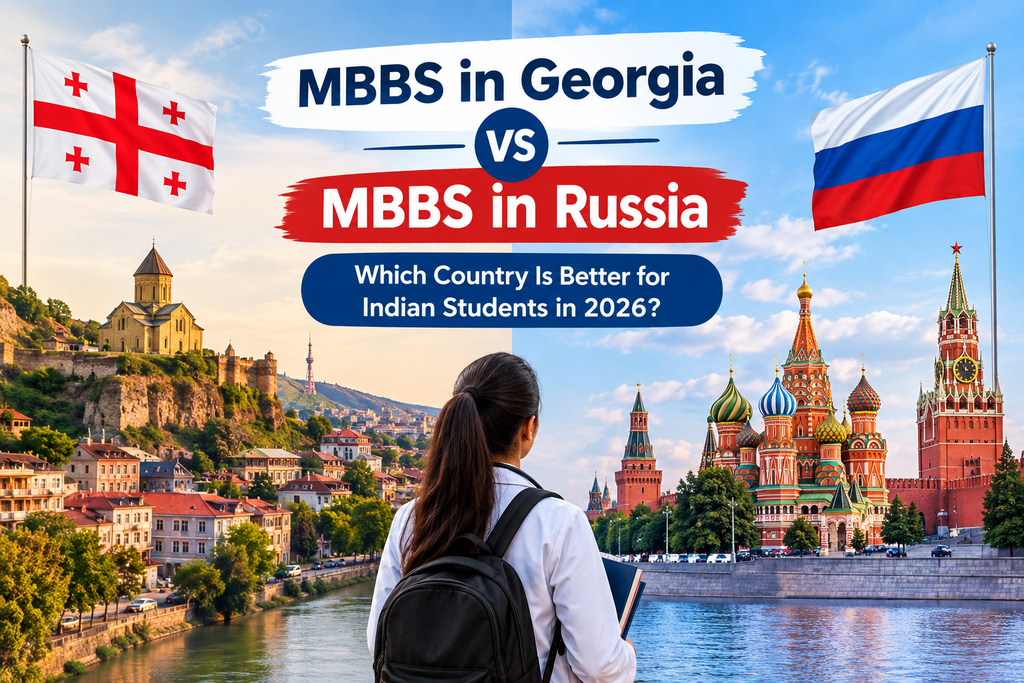
Choosing between MBBS in Georgia vs MBBS in Russia is a major decision for Indian medical aspirants who are unable to secure a government MBBS seat in India or are looking for an international medical education option.
Both destinations offer medical programmes that attract Indian students, but the decision should not be based only on advertised fees or claims such as “NMC approved.” Students should compare the specific university, course structure, clinical training, internship, language, total cost and the NMC requirements applicable to their admission batch.
Quick Answer: Georgia or Russia for MBBS?
Russia is generally the stronger option for students prioritising a wider choice of universities and potentially lower-cost options. Georgia can be attractive for students who prefer an English-focused academic environment, a smaller country and a different European-region student experience.
However, neither country is automatically better for every Indian student. The university and programme you select can matter more than the country itself.
MBBS in Georgia vs MBBS in Russia – Quick Comparison
| Factor | MBBS in Georgia | MBBS in Russia |
| Popularity among Indian students | High | Very high |
| Programme duration | Commonly around 6 years, university-specific | Commonly around 6 years, university-specific |
| Medium of instruction | English-medium programmes available | English-medium programmes available |
| Local language | Georgian; other languages may be encountered | Russian |
| Tuition cost | Generally moderate to high | Wider range, including lower-cost options |
| University choice | More limited than Russia | Broad choice of universities |
| Climate | Generally milder | Very cold in many cities |
| Indian student community | Established | Large and established |
| Clinical exposure | University dependent | University dependent |
| Living cost | City dependent | City dependent |
| NMC pathway | Must meet applicable NMC/FMGL requirements | Must meet applicable NMC/FMGL requirements |
| FMGE data | Institute/year specific | Institute/year specific |
| Best for | Students prioritising English-focused environment and specific universities | Students prioritising choice and potentially lower overall cost |
Important: Avoid treating country-level fee or FMGE averages as guarantees. Current comparison pages show substantial variation between universities within both countries.
MBBS in Georgia vs MBBS in Russia: Which Is More Affordable?
For many Indian families, MBBS fees in Georgia vs MBBS fees in Russia is the first comparison they make.
The important point is that there is no single national MBBS fee for either country.
The actual cost depends on:
- University
- City
- Tuition structure
- Hostel
- Food
- Insurance
- Visa
- Travel
- Currency exchange
- Personal expenses
- Course-specific charges
Recent 2026 comparison data shows that Russia has a broader range of tuition fees, with some universities significantly cheaper than typical Georgian options, while higher-tier Russian universities can overlap with Georgian fees.
Simple verdict –
If your primary priority is affordability, Russia usually deserves to be shortlisted first.
But don’t choose the cheapest university without checking its programme structure, clinical training and regulatory suitability.
MBBS Fees in Georgia for Indian Students
The MBBS fees in Georgia vary by university.
Recent published 2026 comparisons put many Georgian medical programmes roughly in the US$5,000–8,000+ per year range, depending on institution and programme. For example, current comparison data lists universities with annual tuition around US$6,000–8,000.
Typical expenses can include:
| Expense | What to Check |
| Tuition | Annual university fee |
| Hostel/accommodation | On-campus or private |
| Food | Monthly budget |
| Insurance | University/country requirement |
| Visa/residence | Applicable charges |
| Flights | India–Georgia travel |
| Documentation | Translation/attestation etc. |
| Personal expenses | Lifestyle dependent |
Don’t compare tuition alone
A university advertising US$6,000/year may not have the same total cost as another university charging US$7,000/year if accommodation, insurance and other charges differ.
MBBS Fees in Russia for Indian Students
MBBS fees in Russia vary considerably between universities.
Recent 2026 published comparisons show Russian medical universities ranging from approximately ₹3–7+ lakh per year in tuition in examples reviewed, although premium institutions can be considerably higher.
For example, one current comparison lists:
- Stavropol State Medical University — around ₽285,000/year
- Bashkir State Medical University — around ₽405,660/year
- Volgograd State Medical University — around ₽480,000/year
- Kazan State Medical University — around ₽636,000/year
These are illustrative published 2026 figures, not a universal Russia fee structure. Currency exchange rates and university fee orders can change.
Russia’s biggest financial advantage
Russia offers more variation in university and fee levels, allowing students with different budgets to shortlist different institutions.
Georgia vs Russia MBBS Fees: Which Is More Affordable?
Short answer:
Russia generally offers more lower-cost options than Georgia, but the countries’ fee ranges overlap.
This means the statement:
“Russia is always cheaper than Georgia”
is too simplistic.
A better comparison is:
University A in Russia vs University B in Georgia → total six-year cost → clinical training → internship → regulatory suitability.
That is the approach Sukhada Global Education recommends when helping students compare MBBS abroad options.
MBBS Eligibility for Indian Students: Georgia vs Russia
Indian students should evaluate the following basic eligibility factors:
- Class 10 qualification
- Class 12 qualification
- Physics
- Chemistry
- Biology
- NEET qualification
- Age requirements
- Passport
- University-specific admission requirements
Is NEET required?
For Indian citizens/OCI candidates seeking a primary medical qualification abroad, NEET qualification is an important mandatory requirement under the applicable Indian regulatory framework. NMC’s foreign-study guidance specifically addresses the NEET requirement for Indian students seeking primary medical education abroad.
Therefore, students should be cautious about any advertisement promising:
“MBBS abroad without NEET.”
Always verify the rules applicable to your admission year.
MBBS Eligibility in Georgia
A student applying for MBBS in Georgia for Indian students generally needs to satisfy academic and university-specific requirements in addition to the applicable Indian regulatory requirements.
Before applying, verify:
- 12th PCB eligibility
- NEET qualification
- Age
- Passport
- University admission criteria
- Programme language
- Course duration
- Clinical training
- Internship structure
- Regulatory pathway after graduation
MBBS Eligibility in Russia
The same principle applies to MBBS in Russia for Indian students.
Students should evaluate:
- 10+2/12th qualification
- PCB subjects
- NEET
- Age
- Passport
- University-specific requirements
- Medical fitness requirements
- Documentation requirements
The university may have additional application requirements, so students should obtain the current admission checklist before submitting an application.
NMC Rules for MBBS in Georgia and Russia
This is one of the most important sections for Indian students.
A common misconception is:
“If a university is advertised as NMC approved, my degree is automatically valid in India.”
That’s not how students should evaluate foreign medical education.
The NMC currently states that it does not endorse a generic list of foreign medical institutions/universities for MBBS or equivalent courses. Students are advised to verify the relevant foreign institution and programme themselves.
The Foreign Medical Graduate Licentiate Regulations, 2021 (FMGL) specify requirements for foreign medical graduates seeking permanent registration in India. These include, among other requirements, a foreign medical degree course of at least 54 months, a 12-month internship in the same foreign medical institution, English as the medium of instruction, prescribed subjects, registration with the relevant foreign regulator, and the applicable supervised internship/testing requirements in India.
What should students verify?
Before paying a university:
- Exact university
- Exact medical programme
- Course duration
- Medium of instruction
- Curriculum
- Clinical training
- Internship
- Foreign-country registration/licensing
- Applicable NMC regulations
- Requirements applicable to your admission batch
Important 2026 update
NMC continues to publish advisories and FAQs concerning foreign medical education. Its 2026 advisory specifically warns Indian students about foreign medical colleges that may not comply with prescribed regulations.
Therefore, regulatory verification should happen before admission—not after graduation.
MBBS Duration in Georgia vs Russia
Both MBBS in Georgia and MBBS in Russia are commonly marketed as approximately six-year medical programmes.
However, students should not select a programme solely because an agent says:
“It’s been six years.”
The academic programme + clinical training + internship structure matters.
Under the FMGL Regulations, 2021, the foreign medical degree course must meet the applicable minimum duration requirements, including a minimum 54-month foreign medical degree course, alongside the required internship structure.
Georgia
Many Georgian medical programmes are structured around approximately six years.
Russia
Russian medical programmes commonly span approximately six years as well.
What should you ask?
Before admission, ask the university:
“Please provide the complete course structure, clinical training schedule and internship details for the programme in which I will be enrolled.”
Medium of Teaching and Language
This is one of the most important practical differences.
MBBS in Georgia
Many programmes targeted at international students are delivered in English.
However, students should still ask:
- Are lectures in English?
- Are practical classes in English?
- Are examinations in English?
- What language is used in hospitals?
- Is local-language training provided?
MBBS in Russia
English-medium medical programmes are available, but Russian can become important during clinical interaction with patients.
Recent comparisons identify language as one of the major practical differences between the two destinations.
Winner for English-focused student experience?
Georgia may have an advantage for students who strongly prioritise an English-focused clinical environment.
But verify the exact university instead of assuming every programme has identical language arrangements.
Medical Universities and Recognition
This is another area where SEO articles often become misleading.
You may find online lists titled:
“NMC approved medical universities in Georgia”
or
“NMC approved medical universities in Russia.”
But NMC itself states that it does not endorse a generic list of foreign medical institutions/universities for MBBS/equivalent courses.
So how should students select a university?
Evaluate:
University → Programme → Curriculum → Clinical training → Internship → Local registration → NMC requirements
rather than:
Country → “NMC-approved list” → Lowest fees
Medical Universities in Georgia
Students commonly research Medical universities such as:
- Tbilisi State Medical University
- David Tvildiani Medical University
- University of Georgia
- Georgian National University SEU
- Other universities offering international medical programmes
However, availability, programme status, admission rules and regulatory suitability can change.
Always verify the exact programme before applying.
Medical Universities in Russia
Russia offers a much larger range of medical universities and cities.
Students commonly research institutions such as:
- Kazan State Medical University
- Sechenov University
- Pavlov University
- Bashkir State Medical University
- Volgograd State Medical University
- Stavropol State Medical University
- Other regional medical universities
The important point is that “top university” should not simply mean “most famous university.”
For an Indian student, the right university should fit:
Budget + academics + clinical exposure + language + programme structure + regulatory requirements.
Cost of Living: Georgia vs Russia
Living costs can vary significantly by city.
Georgia
Tbilisi is the most common destination considered by international students and can have higher accommodation costs than smaller cities.
Recent university-level information and comparison sources place student living expenses broadly around a few hundred US dollars per month, depending heavily on accommodation and lifestyle.
Russia
Russia’s living costs vary dramatically by city.
A student in Moscow or St Petersburg may have a very different budget from a student in a regional university city.
Monthly budget categories
- Accommodation
- Food
- Transport
- Mobile/internet
- Study materials
- Personal expenses
- Clothing
- Medical expenses
Cost-of-living verdict
Russia offers more variation because of its much larger geographic and university-city spread. Georgia offers a more compact study destination but Tbilisi should not automatically be considered cheap.
Safety and Student Life for Indian Students
Safety should be assessed at the city and university level, not simply by country.
Students and parents should check:
- University campus security
- Hostel security
- Emergency support
- Public transport
- Student support office
- Indian student community
- Local laws
- Current government travel advisories
Georgia
Georgia may appeal to students who prefer a smaller country and relatively compact urban environment.
Russia
Russia has a much larger geographic area, meaning student experience varies considerably between cities.
A student’s experience in one Russian city should not be treated as representative of every Russian university city.
Clinical Exposure and Internship Opportunities
This is where parents should go beyond marketing claims.
Ask the university:
1. Which hospitals are affiliated with the medical programme?
2. From which year does clinical training begin?
3. How much patient interaction do students receive?
4. What is the language used in clinical settings?
5. Where is the internship conducted?
6. Is the internship part of the foreign medical programme?
7. Does the programme satisfy the requirements applicable to my admission batch?
The FMGL framework requires the foreign medical education and internship to satisfy specified requirements, including a minimum 12-month internship in the same foreign medical institution for graduates governed by those regulations.
Which country has better clinical exposure?
There is no reliable country-wide winner.
The correct comparison is:
University A’s teaching hospital vs University B’s teaching hospital.
FMGE/NExT and Medical Career Prospects After MBBS Abroad
Indian students should think about their career pathway before admission.
After completing foreign medical education, students must comply with the licensing framework applicable to them in India.
The FMGL Regulations provide for the applicable examination/testing and registration requirements.
NBEMS continues to publish institute-wise FMGE performance data, including data for 2025 and earlier years.
Important:
Don’t choose Georgia simply because someone says:
“Georgia has a higher FMGE rate.”
And don’t choose Russia simply because someone says:
“Russia has more NMC colleges.”
Neither statement is sufficient for an individual student.
FMGE performance varies by university
NBEMS’s institute-wise data demonstrates why students should examine the specific institution and year, rather than relying on a single country-wide percentage.
Georgia vs Russia FMGE: What Does the Data Tell Us?
This is one of the biggest content gaps in many generic comparison blogs.
Some 2026 comparison pages cite 2024 country-level figures of approximately:
- Russia: 3,331 passes from 11,276 candidates — 29.54%
- Georgia: 1,505 passes from 4,221 candidates — 35.66%
These figures have been reproduced by current comparison sources using NBEMS data.
But don’t turn this into a promise.
A country-level FMGE percentage:
- Does not predict an individual student’s result.
- Does not prove one country’s universities are universally better.
- Can change every year.
- Can conceal large differences between universities.
NBEMS provides institute-wise performance information, making university-specific evaluation more useful than simply saying “Georgia wins FMGE.”
Georgia vs Russia – Which Country Is Better for MBBS?
Let’s make the decision easier.
Choose Georgia if you prioritise:
- English-focused medical education
- A smaller country and urban environment
- Selected medical universities
- Potentially more straightforward English-language interaction
- A milder climate compared with many Russian cities
Consider Russia if you prioritise:
- Wider university selection
- More budget tiers
- Large Indian student communities
- More city choices
- Established medical universities
- Potentially lower overall cost
Georgia vs Russia: Decision Matrix for Indian Students
| Student Priority | Better Fit |
| Lower-budget options | Russia |
| Wider university choice | Russia |
| English-focused environment | Georgia |
| Smaller country | Georgia |
| Milder climate | Georgia |
| Large Indian student community | Russia |
| More city choices | Russia |
| Country-level FMGE comparison | Neither — compare universities |
| NMC compliance | Both require university/programme verification |
| Clinical exposure | University dependent |
| Best overall | Depends on student profile |
MBBS in Georgia vs Russia: Our Verdict
So, Georgia or Russia for MBBS?
For budget-conscious Indian students who want more university choices, Russia may be the more practical starting point.
For students who place greater importance on an English-focused environment, smaller destination and selected universities, Georgia may be attractive.
But neither should be selected simply because:
- An agent says it is “NMC approved”
- The fee is the lowest
- A YouTube video calls it the “best country”
- A website publishes one FMGE percentage
- A university appears in a generic “top 10” list
The best country is the one where the specific university fits your:
Academic profile + budget + regulatory pathway + clinical training + career goal.
MBBS Admission Planning: Georgia vs Russia
For students targeting the 2027–28 academic session, early planning is strongly recommended.
| Period | Recommended Activity |
| Sep–Dec 2026 | Research countries and universities |
| Dec 2026–Feb 2027 | Profile and budget assessment |
| Jan–Apr 2027 | University shortlisting |
| Feb–Jun 2027 | Application/document preparation |
| May–Aug 2027 | Admission and visa processing |
| Aug–Sep 2027 | Travel and university joining |
Important
There is no single universal application deadline for every medical university in Georgia or Russia.
Deadlines and intake dates are university-specific and can change.
Therefore, students should confirm the 2027 intake opening, last application date, admission availability and visa timeline directly with the university or an authorised counselling team before making financial commitments.
Hidden Costs Students Should Include in Their MBBS Budget
One of the most commonly missed points in MBBS abroad comparisons is the difference between:
“Tuition fee”
and
“Total cost of studying MBBS.”
Your complete budget can include:
- Tuition
- Hostel
- Food
- Medical insurance
- Visa
- Residence-related charges
- Flights
- Document translation
- Attestation
- Admission charges
- Local transport
- Books
- Winter clothing
- Personal expenses
- Emergency fund
- Currency exchange charges
Lead-generation tip for parents
Before choosing a country, ask for a written university-wise cost sheet rather than relying on a verbal “₹XX lakh package.”
10 Questions to Ask an MBBS Abroad Consultant Before Admission
This can save parents from costly mistakes.
1. Is the exact university and programme suitable under the current NMC framework?
2. What is the complete six-year cost?
3. What is excluded from the quoted fee?
4. Where will clinical training happen?
5. Where will the internship happen?
6. What language is used with patients?
7. Can you provide the official university fee structure?
8. What happens if admission or visa is unsuccessful?
9. What are the university’s recent FMGE performance figures, if available?
10. Which documents will I receive directly from the university?
A transparent consultant should be comfortable answering these questions.
Why Choose Sukhada Global Education for MBBS Abroad?
Students from Mysuru, Bengaluru and across Karnataka can use Sukhada Global Education for personalised MBBS-abroad counselling.
Sukhada Global Education currently provides MBBS admission and support services for destinations including Russia, Georgia, Kazakhstan, Uzbekistan and Kyrgyzstan.
The consultancy’s approach focuses on helping students understand:
- Eligibility
- Country selection
- University selection
- Fees
- Living costs
- Application
- Admission documentation
- Visa process
- Pre-departure preparation
- Arrival support
Instead of recommending the same country to every student, the better approach is to compare options based on the student’s NEET qualification, academic profile, budget and career plans.
Get a Personalised Georgia vs Russia Comparison
If you’re confused between MBBS in Georgia vs Russia, Sukhada Global Education can help you create a university-level comparison based on your profile.
Based in Mysuru, Karnataka
MBBS destinations: Russia, Georgia, Kazakhstan, Uzbekistan & Kyrgyzstan
Talk to an MBBS Abroad Counsellor Before Choosing Your University
FAQs – MBBS in Georgia vs Russia
1. Is Georgia or Russia better for MBBS?
There is no universal winner. Russia can be better for students prioritising university choice and affordability, while Georgia can suit students prioritising an English-focused environment and a smaller destination. The individual university should be evaluated before the country.
2. Is MBBS in Georgia cheaper than Russia?
Generally, Russia offers more lower-cost university options, although fee ranges overlap. The actual difference depends on the university, hostel, living expenses and exchange rates.
3. Is MBBS in Russia valid in India?
A foreign medical degree does not automatically provide the right to practise medicine in India. Graduates must meet the applicable NMC/FMGL and licensing requirements. NMC also advises students to verify foreign institutions and programmes rather than relying on generic “approved university” lists.
4. Is MBBS in Georgia valid in India?
Students must satisfy the applicable NMC/FMGL requirements and other registration conditions. The specific university and programme should be verified before admission.
5. What is the MBBS fee in Georgia for Indian students?
Fees vary by university. Current 2026 comparisons show many programmes around US$5,000–8,000+ per year, but students should confirm the current official fee structure for their chosen university.
6. What is the MBBS fee in Russia for Indian students?
Russia has a broad fee range. Current published 2026 university figures reviewed for this comparison range from roughly ₹3 lakh to ₹7 lakh+ per year at selected institutions, with premium universities potentially higher.
7. Is NEET required for MBBS in Georgia?
Indian students seeking a primary medical qualification abroad need to meet the applicable NEET requirement under the Indian regulatory framework.
8. Is NEET required for MBBS in Russia?
Yes, Indian students should satisfy the applicable NEET requirement for foreign medical education. Students should not rely on claims that they can legally bypass the requirement.
9. Which has better FMGE results, Georgia or Russia?
Recent 2024 country-level data reported from NBEMS shows Georgia ahead of Russia in that particular dataset, but country averages should not be treated as a guarantee. NBEMS publishes institute-wise performance, so students should compare the specific universities.
10. Is MBBS in Georgia taught in English?
Many programmes for international students are taught in English. However, students should verify the exact programme’s language of instruction and the language used during clinical interaction.
11. Is MBBS in Russia taught in English?
English-medium programmes are available, but Russian can be important during clinical interaction with patients. Students should confirm the language structure with the university before admission.
12. Which country has better clinical exposure, Georgia or Russia?
Neither country can be declared universally better. Clinical exposure depends on the university, teaching hospital, patient volume, rotations and internship structure.
13. How many years has MBBS been in Georgia?
Many Georgian medical programmes are structured around six years, but students should verify the exact programme duration and internship structure before admission.
14. How many years has MBBS been in Russia?
Many Russian medical programmes are commonly structured around six years. The exact course and internship structure should be verified against the university’s official documentation and applicable NMC requirements.
15. Which is the best country for MBBS abroad: Georgia or Russia?
There is no single best country for every Indian student. Russia is often attractive for budget and university choice, while Georgia can appeal to students seeking an English-focused environment and a smaller destination. The best choice depends on the student’s profile and selected university.